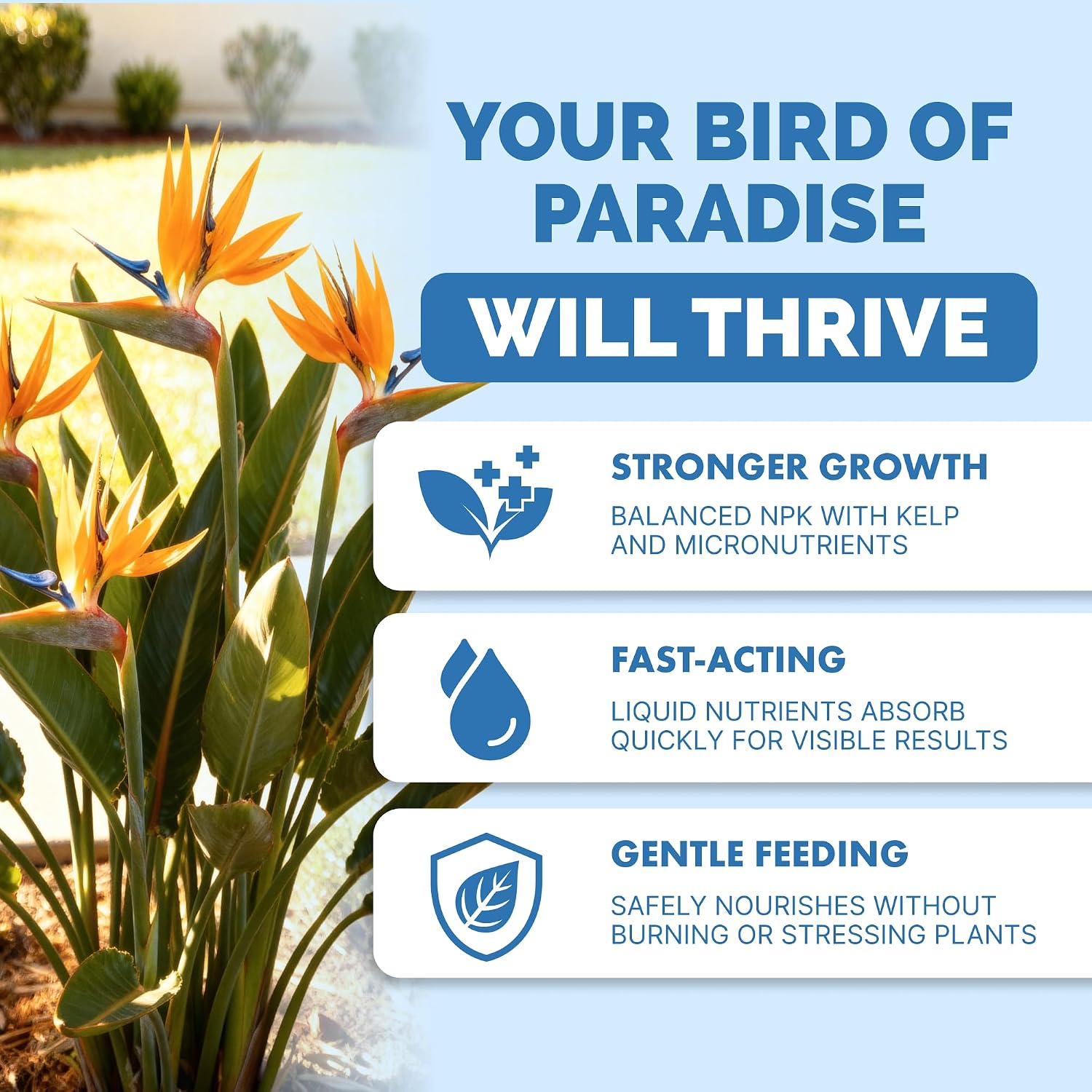
If you’ve landed here because your bird of paradise (the iconic orange-and-blue flowering plant, Strelitzia reginae, whose blooms look exactly like a tropical bird mid-flight) has been sitting in the ground or in a pot for three years with zero flowers, you’re in the right place. The most common explanation you’ll hear is “just wait — it takes time.” That’s not wrong, but it’s incomplete. What nobody tells you is that soil drainage, root crowding, and the type of fertilizer you’re using all interact to either accelerate or delay flowering by years. This article gives you the decision framework — soil mix, fertilizer schedule, container versus in-ground tradeoffs, and the specific numbers — to reasonably expect blooms before year five rather than year seven or eight.
| EDITOR'S PICKJack's Classic 16-5-25 Tropical… | Mid-tier[Grow More Urea-Free Hawaiian Bu…](https://www.amazon.com/dp/B00UBY27YC?tag=greenflower20-20) | Budget pick[SUPERthrive The Original Vitami…](https://www.amazon.com/dp/B000OM82J0?tag=greenflower20-20) | |
|---|---|---|---|
| NPK ratio | 16-5-25 | 5-50-17 | — |
| Form | Water-soluble | Water-soluble | Liquid concentrate |
| Weight | 1.5 lbs | 1.5 lbs | 4 fl. oz. |
| Urea-free | — | ✓ | — |
| Micronutrients | ✓ | — | — |
| Bloom booster | ✗ | ✓ | — |
| Price | $23.75 | $16.99 | $15.39 |
| See on Amazon → | See on Amazon → | See on Amazon → |
Why Bird of Paradise Blooms Late (and What You Can Actually Control)
The Missouri Botanical Garden’s Strelitzia reginae profile notes that plants typically require three to five years from a division or a large nursery specimen, and up to seven years from seed, before reliable blooming begins. That’s a wide range — and the spread is almost entirely determined by cultural conditions, not genetics.
There are two things you cannot control: the plant’s age at purchase and how root-bound it was before you got it. Everything else is your leverage.
The three variables that matter most are:
-
Root confinement — Strelitzia reginae blooms more reliably when its roots are somewhat crowded. This is not a myth. The University of Hawaii CTAHR production guide for commercial Strelitzia growers specifically flags that overpotting (putting a plant in a container much larger than its root ball) delays flowering because the plant redirects energy into root expansion rather than reproduction. This is the single most counterintuitive fact about bird of paradise culture.
-
Phosphorus availability — Phosphorus is the nutrient responsible for root development and flower initiation (the “P” in any fertilizer NPK ratio printed on the bag). A soil that locks up phosphorus — either through extreme pH, compaction, or waterlogging — starves the bloom cycle even if you’re feeding on schedule.
-
Drainage — Bird of paradise is native to the Eastern Cape of South Africa, where soils are gritty, fast-draining, and nutrient-lean. Fine Gardening’s guide to getting Strelitzia to bloom is blunt on this point: standing water at the root zone is the fastest path to rot and the slowest path to flowers.
These three interact. A plant in bad soil can’t use the fertilizer you’re giving it. A plant in a too-large container prioritizes roots over blooms. Get all three right, and the timeline compresses.
The Soil Setup: What to Use In-Ground vs. In Containers
In-Ground Planting
If you’re in USDA hardiness zones 10–12 (coastal Southern California, South Florida, Hawaii), in-ground is the long-term play for the largest, most floriferous specimens. The UF IFAS Extension bird of paradise culture guide recommends amending native soil with coarse sand or perlite (the white, volcanic-glass particles used to improve drainage) at a ratio of roughly 1 part amendment to 3 parts native soil when your base soil has significant clay content.
Target soil pH: 5.5 to 7.0. The Spruce’s bird of paradise growing guide identifies pH drift above 7.5 as a common reason fertilizer programs fail — alkaline conditions (high pH) bind phosphorus into forms the plant cannot absorb, no matter how much you apply.
If your native soil is already sandy loam — common in Hawaii’s coastal lowlands and parts of South Florida — you may need only minimal amendment. Test before you dig. A basic soil test kit (the kind available at most independent garden centers for under $15) gives you pH and a rough nutrient baseline.
In-ground soil build:
- Native soil: 70–75%
- Coarse perlite or gritty sand (not play sand): 20–25%
- Aged compost: 5–10% (for organic matter and microbial activity — keep this fraction low; too much compost retains moisture)
Container Planting
This is where most mainland gardeners will be working, especially if you’re in zones 7–9 and overwintering indoors. Container culture gives you total control over soil chemistry — which is an advantage — but introduces the drainage challenge of a closed system.
Container mix:
- High-quality cactus/succulent potting mix as the base: 50%
- Perlite: 30%
- Orchid bark (medium grade): 20%
The orchid bark does two jobs: it creates macropore space (large air gaps that prevent compaction) and it decomposes slowly, feeding a small amount of organic matter over years without building up the water retention that standard potting mix creates. Owners of container-grown bird of paradise who report early blooms frequently cite this kind of chunky, fast-draining mix in aggregated growing forums and in the commentary sections of specialty nursery care guides.
Container size rule: For a plant in a 1-gallon nursery container, move to a 3-gallon maximum. For a 3-gallon specimen, move to a 5-gallon. Stop there. Resist the impulse to “give it room to grow.” A bird of paradise in a 15-gallon container with a root ball that only fills a 5-gallon volume is prioritizing root expansion. The CTAHR production guide’s recommendation for commercial cut-flower growers — maintain moderate root confinement — translates directly to hobbyist container culture.
The Fertilizer Schedule That Actually Moves the Needle
By the Numbers
| Growth Phase | NPK Target | Application Frequency | Notes |
|---|---|---|---|
| Spring push (March–May) | 10-30-10 or similar high-P | Every 3–4 weeks | Phosphorus front-loads bloom initiation |
| Active growth (June–August) | Balanced 10-10-10 | Every 4 weeks | Sustain without overfeeding nitrogen |
| Wind-down (Sept–Oct) | 0-10-10 or low/no N | Once in September | Reduce nitrogen; harden growth |
| Dormant/slow (Nov–Feb) | None | Skip entirely | Salts accumulate if you feed in cold/slow periods |
NPK stands for nitrogen (N), phosphorus (P), and potassium (K) — the three primary plant nutrients printed as a ratio on every fertilizer label. A 10-30-10 fertilizer has three times as much phosphorus as nitrogen or potassium, which is why it’s used to push flower development.
Why High-Phosphorus in Spring
Flower buds on bird of paradise are initiated (set in motion by the plant’s internal chemistry) in late winter through spring. By the time you see a bud emerging from the leaf axil (the joint where leaf meets stem), the initiation decision was made weeks earlier. If phosphorus was unavailable during that window, no amount of fertilizer applied after the fact recovers the season.
The UF IFAS Extension guide on bird of paradise culture in Florida identifies the March–May period as the critical feeding window for Florida-grown specimens. This timing maps closely to zone 10–12 Hawaii growing conditions, where the University of Hawaii CTAHR data similarly flags early spring as the key nutritional period.
For container growers in cooler zones who overwinter indoors, shift this window two to four weeks later to match when the plant experiences its first consistent warmth — typically when nighttime temps stabilize above 55°F (13°C).
Fertilizer Form Matters
Liquid fertilizers (water-soluble concentrates you mix and apply with irrigation) act faster but require more frequent application. Slow-release granular fertilizers (coated pellets that release nutrients over 3–6 months) are more forgiving for irregular schedules but give you less precision during the critical spring push.
The approach that reviewers and specialty growers consistently describe as most effective is a combination: a slow-release granular at the start of the growing season as a baseline, supplemented with a liquid high-phosphorus feed every three to four weeks during the March–May window. This covers both the sustained background nutrition and the targeted bloom-initiation push.
Container vs. In-Ground: The Decision Frame
If your situation is X, here’s the honest tradeoff:
You’re in zone 10–12 and planting long-term: Go in-ground. Once established (18–24 months), in-ground plants outperform containers in both bloom count and specimen size. The tradeoff is that you lose the ability to adjust root confinement. Prepare the bed correctly once, and the plant rewards you for a decade.
You’re in zone 7–9, overwintering in a garage or sunroom: Containers are your only viable path for year-round growing. Accept slightly delayed bloom timelines relative to in-ground, but know that the fertilizer schedule above — applied consistently — still moves you toward blooms before year five. The key is not skipping the spring phosphorus push just because the plant is indoors.
You bought a large 3–5 gallon nursery specimen (which is the smart move — these are 2–4 years old at purchase): Do not up-pot immediately. Let it adjust for 6–12 months in the nursery container or a container only one size larger. Premature repotting resets the bloom clock by triggering a new root expansion cycle.
You started from seed or a tiny division: Adjust expectations to 4–6 years minimum, but use the soil mix and fertilizer schedule above from the beginning. You’re building the foundation early; the compound effect is real.
A Note on Watering and Flush Cycles
Fertilizer salt buildup (the white crusty residue you sometimes see on the rim of terracotta pots) is a legitimate bloom inhibitor in containers. Salt accumulation in the root zone interferes with water uptake and nutrient absorption. The Spruce’s bird of paradise growing guide recommends a flush — running plain water through the container until it drains freely, two to three times the pot’s volume — once per season, typically in early spring before the fertilizer push begins, to reset the soil chemistry.
This is especially important if you’ve been fertilizing on a regular schedule. Even well-timed applications accumulate over time in a closed container system. One flush before your March–May window costs nothing and removes a hidden barrier to bloom initiation.
The Bottom Line
Bird of paradise is not a plant that punishes impatience — it punishes incorrect setup. A three-year-old division in the wrong soil, overpotted and fed with a nitrogen-heavy lawn fertilizer, will sit inert for years. The same plant in a chunky, fast-draining mix, confined to a slightly snug container, and fed a phosphorus-forward schedule in spring will surprise you with its first bloom spike before year five in most cases.
Per the University of Hawaii CTAHR’s production framework and the UF IFAS Extension cultural guidance: get the drainage right, keep the roots appropriately confined, and front-load phosphorus when the plant is actively initiating buds. That’s not a complicated protocol — it’s three decisions made once and then repeated each spring. Make them correctly, and the timeline compression is real.