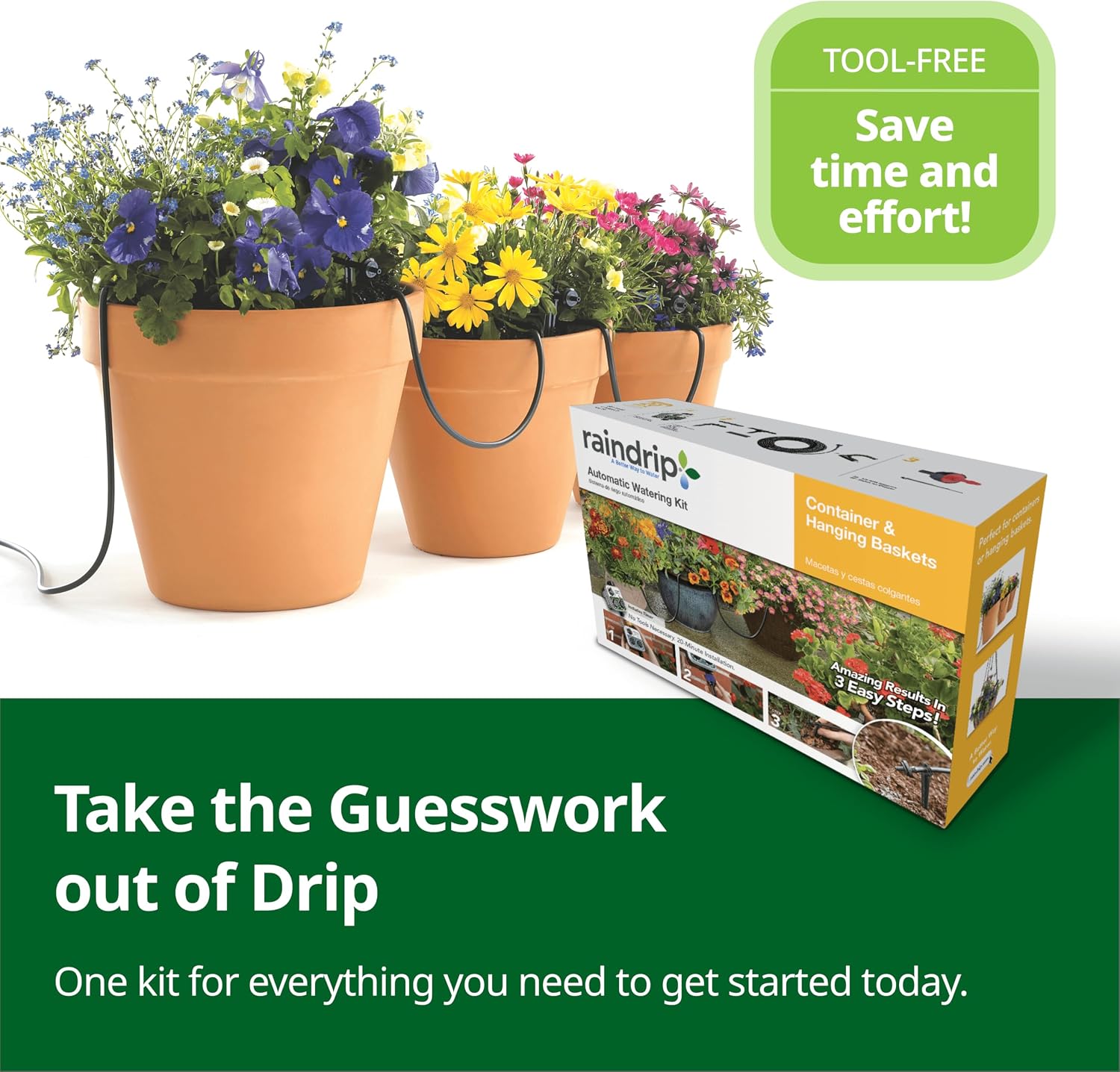
If you’ve been hand-watering a growing collection of tropical container plants — anthuriums, heliconias, gingers, bird of paradise — you already know how fast that chore scales up. One plumeria in a pot is pleasant. Twenty mixed tropicals in a patio layout becomes a daily 45-minute commitment, and missing a single day in midsummer heat can set back a specimen you spent $300 on. That’s where drip irrigation comes in. A drip system delivers water slowly and directly to each plant’s root zone through thin tubing and small fittings called emitters (the tiny nozzles that control exactly how much water each plant gets). A timer — essentially a programmable valve that screws onto your outdoor spigot — automates the whole thing so your plants are watered on schedule whether you’re home or not. This guide walks you through how to choose the right timer-and-emitter combination for a tropical container collection, what the tradeoffs actually look like between budget and mid-range kits, and the specific specs that matter for plants with genuine moisture sensitivity.
| EDITOR'S PICK[CARPATHEN Drip Irrigation Syste…](https://www.amazon.com/dp/B08CRSYCQS?tag=greenflower20-20) | Mid-tier[MIXC 230FT Quick-Connect Drip I…](https://www.amazon.com/dp/B0CP92Y52V?tag=greenflower20-20) | Budget pick[Raindrip R560DP Drip Watering S…](https://www.amazon.com/dp/B00J2NRUBI?tag=greenflower20-20) | |
|---|---|---|---|
| Max plants | — | — | 20 |
| Timer included | ✗ | ✗ | ✓ |
| Tubing sizes | 5/16" & 1/4" | 1/4" & 1/2" | — |
| Adjustable emitters | ✓ | ✓ | — |
| Quick-connect | — | ✓ | — |
| Total tubing | — | 230 ft | — |
| Price | $38.87 | $37.99 | $35.98 |
| See on Amazon → | See on Amazon → | See on Amazon → |
Why Tropical Containers Are a Special Case
Standard irrigation advice written for vegetable beds or lawn zones doesn’t translate cleanly to a curated tropical container setup. Here’s why: your collection almost certainly mixes plants with meaningfully different water needs sitting within a few feet of each other.
A mature Heliconia psittacorum ‘Sassy’ in a 15-gallon nursery container wants consistent moisture and will show stress within 36 hours of drought. Three feet away, a Plumeria obtusa in a well-draining lava-rock mix actively benefits from dry-down periods between waterings. A rare Anthurium veitchii in a mounted sphagnum setup needs frequent, light misting rather than volume-delivery irrigation. One-zone, one-timer, one-emitter-rate systems handle none of this gracefully — which is the central problem practitioners run into when they first try to automate.
Per the University of Hawaii at Manoa College of Tropical Agriculture and Human Resources’ guidance on drip irrigation for Hawaii landscapes, matching emitter flow rate (measured in GPH — gallons per hour) to both the plant’s demand and the container’s drainage rate is the single most impactful decision in a drip setup. Get the flow rate wrong and you’re either drowning roots or delivering water faster than the substrate can absorb, creating runoff that bypasses the root zone entirely.
The University of Florida IFAS Extension’s overview of drip irrigation for home landscapes reinforces this: container plantings require dramatically lower total volume per zone than in-ground beds, but they require higher precision because there’s no surrounding soil buffer to absorb overdelivery. An in-ground plant can drain excess laterally. A container can’t.
The Timer Decision: Battery vs. Smart vs. Multi-Zone
Your timer is the system’s brain, and the choice you make here determines everything downstream about scheduling flexibility. Three categories dominate the market for home-scale tropical collections.
Battery-powered single-zone timers are the entry point — a single unit that screws directly onto a hose bib and runs one watering schedule. They’re reliable, straightforward, and the installed cost of a complete setup (timer plus tubing and emitters for 10–15 containers) typically lands in the $60–$110 range. The tradeoff is zero ability to differentiate schedules within that zone. Every emitter runs at the same time, for the same duration, every cycle. For a uniform collection — say, a matched set of gingers or a row of identically potted Strelitzia nicolai — this is entirely sufficient. For a mixed collection, you’re engineering around the timer’s limitation by choosing different emitter GPH rates to simulate different watering volumes, rather than different schedules.
Brands like Orbit and Rain Bird dominate this space. Across aggregated reviews at The Spruce and Fine Gardening, the consistent owner complaint about single-zone battery timers is battery drain in humid climates — the seals on cheaper units allow moisture intrusion that shortens battery life noticeably in coastal Hawaii conditions or high-humidity mainland zones (USDA Zones 9b–11).
Bluetooth and Wi-Fi smart timers add app-based scheduling and, critically, rain-skip or weather-intelligence features. In a tropical climate where rainfall is erratic and containers may be under a lanai overhang (sheltered from rain but still experiencing high ambient humidity), a timer that integrates local weather data provides real value. Rachio and Orbit B-hyve are the most commonly reviewed options in this category, with single-zone smart units landing in the $40–$80 range and multi-zone smart controllers running $80–$180+. Fine Gardening’s irrigation coverage consistently notes that smart timers earn back their premium primarily when you’re managing the system remotely or dealing with variable rainfall — both extremely relevant for Hawaii residents who travel and mainland gardeners running a covered tropical patio through monsoon-pattern summers.
Multi-zone manifold systems — where a single controller drives 2–6 independent valve zones — are the practitioner-level answer to the mixed-collection problem. Each zone runs on its own schedule and duration, which means your moisture-hungry heliconias run twice daily while your plumerias run every other day. Installed cost for a 2-zone setup with controller, manifold, tubing, and emitters for 20–30 containers typically runs $150–$280 depending on brand and run length. This is where the math starts favoring the investment clearly: at $300–$600 per specimen in a collector-grade collection, the insurance value of reliable, species-appropriate watering schedules is significant.
Emitter Selection: The Detail Most Kits Get Wrong
Most starter drip kits include a single emitter type — usually 0.5 GPH or 1 GPH drippers — and call it a day. For a mixed tropical collection, this is where thoughtful practitioners diverge from beginners.
By the Numbers: Common Emitter Rates and Use Cases
| Emitter Rate | Typical Use in Tropical Containers |
|---|---|
| 0.5 GPH | Mounted orchids, bromeliads, small sphagnum setups |
| 1 GPH | Most anthuriums, gingers in well-draining mix |
| 2 GPH | Heliconias, large bird of paradise in 15–25 gal containers |
| 0.5–2 GPH adjustable | Mixed collections, collector setups with diverse species |
Missouri Botanical Garden’s watering guidance for potted plants notes that tropical species in containers dry out faster than temperate species at equivalent temperatures, due to higher transpiration rates — meaning that a 1 GPH emitter that’s adequate in Zone 7 may underdeliver for the same container size in Zone 10 midsummer heat. Plan for higher emitter rates, or higher run-frequency, as ambient temperature climbs.
Pressure-compensating emitters are worth the additional cost — typically $0.30–$0.80 more per emitter — if your system runs any elevation change between containers or if your water pressure varies during the day. Non-compensating emitters deliver different flow rates at different pressures, which means the container at the end of a long tubing run gets meaningfully less water than the container closest to the source. Pressure-compensating models maintain rated GPH across a wider pressure range (typically 15–50 PSI), eliminating that drift. For a collection where each container represents a real investment, consistent delivery across all emitters matters.
Micro-spray emitters (sometimes called “misters” or “mini-sprinklers”) are the right answer for mounted plants and sphagnum-wrapped specimens — the Anthurium veitchii problem mentioned earlier. They deliver water as a fine mist over a small radius rather than a drip point, which wets aerial roots and sphagnum media without channeling water through the mount too quickly. These typically run 3–10 GPH at full output but are usually run on very short cycles (30–90 seconds) rather than the longer runs used for soil-based containers.
Building a Practical System: Decision Framework
Here’s the actual decision sequence that makes sense for a practitioner-level collector, framed around collection size and composition:
If your collection is 10–20 containers and relatively uniform in species needs: A quality single-zone battery timer (Orbit 56854 or comparable) paired with a 1/4-inch emitter kit with pressure-compensating drippers is a complete, capable solution. Budget $75–$120 installed. Use different emitter GPH rates to approximate the volume differences between species. Run the system, observe which containers are over- or underwatering after two weeks, and swap emitters accordingly. This is the fastest path to automation.
If your collection mixes high-moisture species (heliconias, gingers) with dry-tolerant species (plumerias, some euphorbias used as tropical accent plants) or includes mounted epiphytes: A 2-zone setup is the minimum that handles your actual plant list. Zone 1 runs your moisture-hungry containers on a twice-daily schedule. Zone 2 runs dry-tolerant containers every second or third day. Mounted specimens get a third zone with micro-spray emitters on 60-second cycles at higher daily frequency. Budget $180–$280 for the controller, manifold, and emitters for 25–35 containers.
If you’re managing a collector-grade landscape — $300–$600+ per specimen, rare cultivars, or a design-forward setup you’ve invested significant money in: The smart multi-zone controller with weather integration is the defensible choice. The math is straightforward: if a failed irrigation schedule on a week-long absence kills or sets back two collector-grade specimens, you’ve lost more than the cost differential between a basic timer and a Rachio 3 or comparable smart controller. Remote monitoring and rain-skip logic pay for themselves in collection protection.
On the tubing side: 1/2-inch main line with 1/4-inch distribution tubing is the standard for container layouts. Keep individual 1/4-inch runs under 18 inches when possible — longer micro-tubing runs introduce pressure drop that undermines emitter consistency. Per the University of Florida IFAS Extension’s drip irrigation overview, the most common installation error in home container setups is running 1/4-inch tubing too far from the main line, producing uneven delivery across the system.
One Last Practical Note on Zone 11 and Shipping Season
If you’re on the mainland and ordering emitter kits or timers online during summer shipping windows, the products themselves are obviously not heat-sensitive. But the timing matters in a different way: summer is peak demand season for drip hardware, and some specialty fittings (particularly pressure-compensating emitters in lower GPH ratings) sell out at major retailers in June and July. If you’re planning a system installation for a summer collection buildout, ordering in April or May avoids availability gaps and gives you time to test and adjust emitter placement before peak heat arrives.
For Hawaii residents, CTAHR’s drip irrigation guidance specifically notes that mulching the top of containers significantly reduces evaporation between irrigation cycles — a simple addition that lets you reduce emitter frequency without increasing stress on moisture-sensitive tropicals. A 1–2 inch layer of cinder, shredded bark, or macadamia shell mulch over the container surface extends effective soil moisture retention measurably, which means your automation schedule can be slightly less aggressive than bare-soil container math would suggest.
Set the system up thoughtfully once, spend a couple of weeks dialing in emitter rates and cycle timing, and the daily watering task becomes a periodic check rather than a standing obligation. For a collection that represents real money and genuine horticultural investment, that’s a worthwhile trade.