If you’ve ever stood in the fertilizer aisle holding a bag that says “8-2-12 with Magnesium” and wondered whether that’s what your queen palm actually needs — or whether it even matters — you’re exactly where this article is aimed. Palm fertilization gets confusing fast because palms have nutritional needs that are genuinely different from most other landscape trees. The numbers on a fertilizer bag, called the NPK ratio (nitrogen, phosphorus, and potassium — the three main nutrients plants need, listed in that order as percentages by weight), mean something specific for palms that they don’t mean for your hibiscus or your plumeria. Get the ratio wrong, apply at the wrong time of year, or ignore magnesium — a secondary nutrient palms consume heavily — and you can spend a full growing season watching your palm yellow from the inside out without understanding why. This guide walks through which fertilizer specs matter, why they vary by species and by zone, and how to make the call with confidence when you’re standing in front of a rack of options.
| EDITOR'S PICK7 LB. Perfect Palm ® - Dual Act… | Mid-tierMiracle-Gro Shake 'N Feed Palm… | Budget pick[Dr. Earth Exotic Blend Organic…](https://www.amazon.com/dp/B01N8R92O1?tag=greenflower20-20) | |
|---|---|---|---|
| NPK ratio | — | — | 5-4-6 |
| Weight | 7 lb | 8 lb | 4 lb |
| Organic | — | — | ✓ |
| Measuring scoop | ✓ | — | — |
| Dual action | ✓ | — | — |
| Price | $44.95 | $25.49 | $12.47 |
| See on Amazon → | See on Amazon → | See on Amazon → |
Why Palm Nutrition Is Its Own Category
Most gardeners are used to thinking about fertilizer in terms of “feed plants, they grow.” Palms are more specific than that, and the University of Florida IFAS Extension’s detailed publication on landscape palm fertilization is emphatic on this point: the wrong fertilizer can cause deficiencies that are as damaging as no fertilizer at all.
Here’s the core issue. Palms are monocots — they grow from a single central growing point called the bud or meristem, unlike the multiple growth points of broadleaf trees. Damage or deficiency at that central bud doesn’t get corrected by compensating growth elsewhere. When a queen palm (Syagrus romanzoffiana) develops frizzle top — a condition where new fronds emerge stunted and twisted — it’s almost always manganese deficiency, which often gets confused with magnesium deficiency because both produce yellowing. The fix is different for each, and applying the wrong correction prolongs the problem by a full year or more.
The IFAS publication recommends a palm-specific fertilizer with an NPK ratio close to 8-2-12 (or similar with a 3:1:3 nitrogen-to-potassium ratio) plus magnesium, as a broadly sound starting point for landscape palms. The elevated potassium is intentional: palms are heavy potassium consumers, and most general-purpose fertilizers are underweighted for that demand.
Why potassium matters so much: Potassium (the “K” in NPK) governs water regulation inside plant cells and is essential for disease resistance. Palms in sandy, fast-draining soils — which describes most of coastal Florida, Hawaii’s leeward slopes, and any container growing situation — lose potassium rapidly to leaching. A fertilizer balanced for a rose or a lawn will chronically under-deliver potassium to a palm over time.
Reading the Label for Your Zone
The USDA hardiness zone system divides growing areas by average minimum winter temperature, and it matters significantly for fertilizer timing and nitrogen management. But for tropical palms, the relevant variable isn’t just cold tolerance — it’s the length of your active growing season.
Zone 9b–10a (Gulf Coast Florida, Southern California inland valleys, protected Texas coast)
This is the marginal tropical zone. Palms here experience genuine cool-season dormancy or near-dormancy from roughly November through February. The CTAHR guidance from the University of Hawaii at Manoa and the IFAS Extension both agree: do not fertilize palms when soil temperatures are below 65°F. Applying nitrogen to a dormant or semi-dormant palm pushes new growth that arrives thin, pale, and frost-vulnerable. Timing your applications to the growing season — typically March through September — and splitting into three or four lighter applications outperforms a single heavy spring dump. Slow-release granular formulations with polymer-coated nitrogen (these are fertilizer granules where the nutrient release is slowed by a coating, so the palm gets a steady feed rather than a flood) are strongly preferred here to reduce leaching between applications.
Zone 10b–11 (South Florida, Hawaii, Puerto Rico, Caribbean)
In the true tropical zone, palms grow year-round with no meaningful dormancy. The strategic adjustment here is to reduce nitrogen application during the dry season (roughly November–April in Hawaii’s leeward zones) not because palms stop growing, but because without active rainfall to carry nutrients down to root zones, soluble nitrogen accumulates as salts near the soil surface and can cause tip burn on roots. Fine Gardening’s coverage of palm nutrition notes this as one of the most commonly misunderstood errors among new tropical gardeners — more fertilizer during drought stress does not compensate for drought stress.
In Zone 10b–11, four applications per year remains the recommendation from IFAS, spaced roughly quarterly, with a formulation that includes both magnesium and manganese.
By the Numbers
| Zone | Active Growing Season | Applications/Year | Key Watch Nutrient |
|---|---|---|---|
| 9b–10a | March–September | 3 | Potassium + Mg |
| 10b | Year-round, reduce in dry season | 4 | Mg + Mn |
| 11 (Hawaii) | Year-round | 4 | Mn + Fe (iron) |
Iron (Fe) deficiency appears specifically in Hawaii’s high-pH volcanic soils where alkaline conditions lock iron out of plant availability. If your palms in Hawaii show interveinal yellowing on new fronds (the leaf tissue between the veins turns yellow while the veins stay green), that’s a classic iron chlorosis signal, and the fix is a chelated iron drench — a form of iron that stays plant-available even in alkaline conditions — not a change in NPK.
Species-Level Differences That Change the Formula
This is where cultivar-level thinking pays off. The IFAS Extension and The Spruce’s fertilization guidance both note that species within the palm family have meaningfully different micronutrient sensitivities.
Queen Palm (Syagrus romanzoffiana): The most common manganese-deficient palm in Florida and Southern California. Frizzle top is nearly always manganese. Standard palm fertilizers with manganese (look for Mn listed in the micronutrient panel on the bag) address this, but if the deficiency is established, a supplemental manganese sulfate soil drench accelerates recovery.
Canary Island Date Palm (Phoenix canariensis): A heavy potassium user that shows potassium deficiency as translucent orange-yellow spotting on older fronds — a pattern called “pencil pointing” as leaflets curl inward. Matching the 3:1:3 nitrogen-to-potassium ratio is especially important for this species.
Coconut Palm (Cocos nucifera): Uniquely sensitive to boron deficiency, which presents as distorted new frond growth where leaflets fail to open normally. Coconut palms in containers or in soils that have never received a broad-spectrum palm fertilizer (one that includes boron, molybdenum, and zinc alongside the primary nutrients) show this most often. The CTAHR documentation on Hawaiian palm nutrition specifically flags boron for coconuts grown on the leeward side of the islands.
Areca Palm (Dypsis lutescens): Often grown in containers on lanais or as indoor/outdoor specimens. Container growing eliminates the soil buffer that moderates nutrient availability, so areca palms need more frequent, lighter applications — every 8–10 weeks rather than quarterly — with a formulation specifically labeled for containers or slow-release. The Spruce’s overview of palm fertilization recommends reducing the per-application rate by roughly one-third for containerized specimens versus in-ground.
Foxtail Palm (Wodyetia bifurcata): Fast-growing and notably tolerant of a range of fertilizer programs, but prone to magnesium deficiency in sandy soils. The yellowing on foxtails typically appears first on the older, lower fronds (in contrast to iron deficiency, which shows on new growth). Magnesium sulfate (commonly sold as Epsom salt, though purpose-formulated palm magnesium products deliver it more evenly) applied as a supplemental treatment addresses this when it’s caught early.
The Decision Frame: Choosing a Fertilizer Product
Here’s the practical decision tree when you’re evaluating options, whether you’re sourcing from a big-box garden center or a specialty supplier.
Step 1: Is it labeled specifically for palms? General-purpose tree fertilizers are almost always too high in phosphorus (the middle number in NPK) and too low in potassium. Palms in established landscapes rarely need phosphorus supplementation — most soils already have adequate phosphorus — and excess phosphorus can actually interfere with zinc and iron uptake. The Missouri Botanical Garden’s fertilization guidance reinforces this: established landscape trees, including palms, are typically not phosphorus-limited. If a product has a phosphorus number above 4–5, it’s likely formulated for something else.
Step 2: Does the micronutrient panel include Mg, Mn, Fe, Zn, and B? A palm fertilizer without this suite of micronutrients is a partial solution. The bag should list these on the guaranteed analysis panel (the table of nutrient percentages required by law on every fertilizer label). If manganese, iron, and boron aren’t listed, keep looking.
Step 3: Is the nitrogen slow-release? Look for terms like “polymer-coated,” “sulfur-coated,” or “controlled-release” nitrogen in the ingredients list. The IFAS Extension explicitly recommends that at least 30% of total nitrogen in a palm fertilizer should come from slow-release sources. Fast-release nitrogen causes the salt accumulation and growth-flush problems mentioned above.
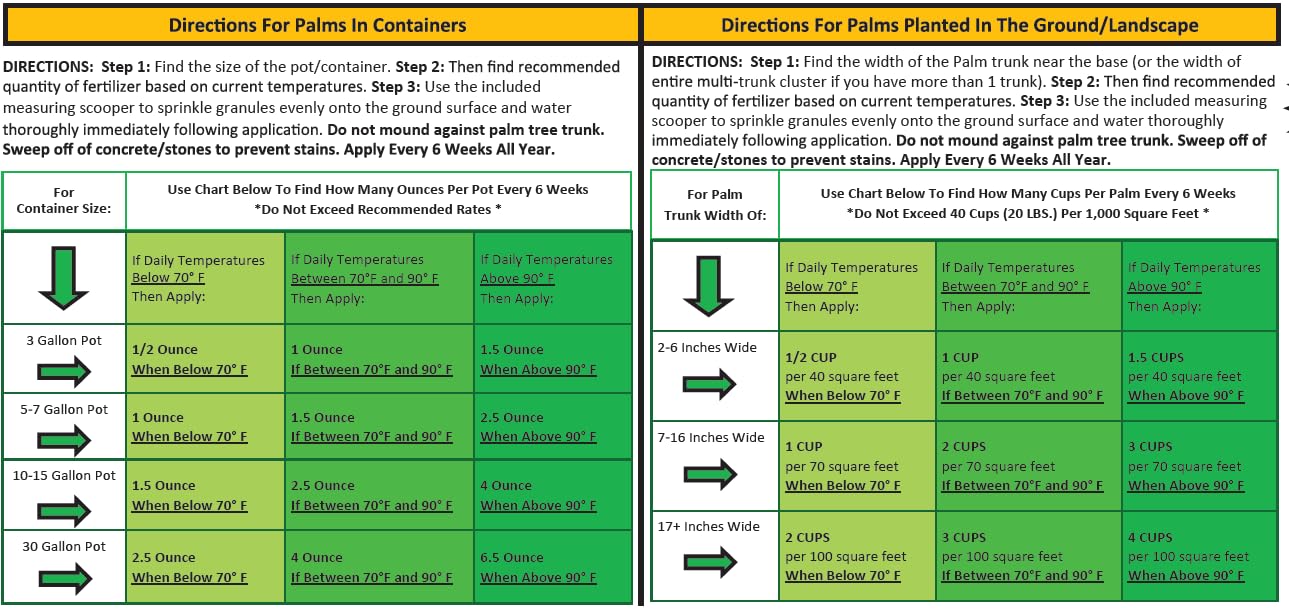
Step 4: Match application rate to your situation In-ground, established palm in Zone 10b+: quarterly at label rate. Container palm: every 8–10 weeks at 30% reduced rate. Newly transplanted palm: hold fertilization entirely for the first 3–4 months — the IFAS Extension is firm on this. A stressed, newly planted palm cannot use the nutrients, and fertilizer salts in the root zone of a recently disturbed root system can cause root tip burn when the palm is least able to recover.
If X, Then Y: The Decision Rules
-
If you’re in Zone 9b–10a and your palm yellowed over winter: Hold fertilizer until soil temps are reliably above 65°F, then start with a quarter-rate application and watch for 3–4 weeks before going to full rate. Yellowing during cool months is often cold stress, not deficiency, and heavy fertilization won’t fix it.
-
If you have a queen palm with twisted, stunted new fronds: Prioritize manganese sulfate as a soil application immediately, then switch to a palm fertilizer that explicitly includes manganese in the micronutrient panel. Don’t wait for the standard quarterly cycle — manganese deficiency progresses.
-
If your containerized areca palm looks pale and growth has stalled in peak summer: Reduce application interval to 8 weeks with a slow-release granular formulation, and confirm that drainage is not creating a wet/saturated root zone — nutrient uptake failure in containers is as often drainage-related as it is fertilizer-related.
-
If your Hawaii coconut is producing distorted new fronds: The primary suspect is boron deficiency. A palm fertilizer with boron listed in the micronutrient analysis, applied quarterly, addresses this for most in-ground specimens within two growing cycles.
-
If you’re spending $300–$600 on a specimen palm: Budget the fertilization program into year-one costs. A $400 specimen foxtail or a rare bismarckia deserves a purpose-formulated palm fertilizer applied on a consistent quarterly schedule from the moment it’s established in the ground — not a bag of generic slow-release grabbed as an afterthought. The investment in correct nutrition from the first season is what separates a specimen that thrives from one that limps along and never fulfills its potential.
The fertilizer label is a contract with your palm. Read it at the cultivar level, match it to your zone and season, and the math works in your favor.