If you’ve landed here trying to figure out why your heliconias look crispy at the edges even though you’re watering regularly, or why your giant taro keeps wilting between sessions while your plumeria seems fine, you’re in exactly the right place. Drip irrigation — a system that delivers water slowly and directly to a plant’s root zone through small fittings called emitters (think of them as tiny, controlled drippers screwed into tubing) — solves both problems when it’s sized correctly. The challenge in a mixed tropical bed is that heliconias, gingers, and aroids don’t all drink at the same rate or from the same depth. This guide walks through the actual math for matching emitter flow rates to plant type, explains which off-the-shelf kits handle that variety without a plumber or an engineering degree, and ends with a clear decision framework so you can commit to a setup with confidence.
| EDITOR'S PICK172FT Drip Irrigation System Ki… | Mid-tier[CARPATHEN Drip Irrigation Syste…](https://www.amazon.com/dp/B08CRSYCQS?tag=greenflower20-20) | Budget pick[Rain Bird DRIPKITBAG Drip Irrig…](https://www.amazon.com/dp/B0CB75HHNG?tag=greenflower20-20) | |
|---|---|---|---|
| Emitter type | 360° adjustable nozzles | Adjustable sprinkler emitters | — |
| Tubing size | 1/2" mainline | 5/16" & 1/4" | — |
| Timer included | ✓ | — | — |
| Zones | 2 | — | — |
| Price | $79.99 | $38.87 | $31.47 |
| See on Amazon → | See on Amazon → | See on Amazon → |
Why Tropical Beds Break Standard Irrigation Rules
Most drip irrigation guides are written for vegetable rows or rose beds — plants of roughly uniform size, spaced evenly, with similar water demands. A mixed tropical bed works nothing like that.
Consider a typical collector’s bed in a Florida or Hawaiian garden: a Heliconia psittacorum ‘Sassy’ in full sun at one end, a clump of Alpinia zerumbet (shell ginger) in partial shade in the middle, and a Philodendron gloriosum or Alocasia macrorrhiza tucked under the canopy at the back. Per Missouri Botanical Garden’s cultural notes on heliconia and ginger, mature heliconias in active growth can require the equivalent of 1.5 to 2 inches of water per week — up to three times what a well-established aroid in shade demands during the same period. Running a single emitter flow rate across all three plants means you’re either starving the heliconia or drowning the aroid.
The University of Hawaii at Manoa CTAHR’s drip irrigation guidance for landscapes makes a related point: the goal of any drip system is uniform distribution efficiency — getting the right volume to each root zone, not just the average volume across a bed. In a tropical mixed planting, that means you need variable flow emitters (emitters you can set to different drip rates, typically measured in gallons per hour, or GPH) or a layout that groups plants by water demand into separate irrigation zones (independently controlled sections of tubing).
This is the core tradeoff every intermediate grower hits: single-zone simplicity vs. multi-zone precision. Let’s put numbers on both.
The Emitter Math: GPH, Root Zone, and Soil Type
Before choosing a kit, you need three inputs per plant group:
- Water demand in gallons per week (derived from the plant’s requirements and your bed’s square footage per plant)
- Emitter GPH rating (what the emitter delivers per hour)
- Run time per session (how many hours your timer runs)
The formula is straightforward:
Gallons needed per session ÷ Run time (hours) = Required emitter GPH
By the Numbers: Typical Tropical Plant Water Demands
| Plant Group | Weekly Water Target | Sessions/Week | Per-Session Need | Target Emitter GPH (2-hr run) |
|---|---|---|---|---|
| Heliconias (full sun, active growth) | 1.5 – 2 gal per plant | 3 | 0.5 – 0.67 gal | 0.5 GPH emitter |
| Gingers (Alpinia, Zingiber) | 1 – 1.5 gal per plant | 3 | 0.33 – 0.5 gal | 0.5 GPH emitter |
| Large aroids (Alocasia, Colocasia) | 0.75 – 1 gal per plant | 2–3 | 0.25 – 0.5 gal | 0.25–0.5 GPH emitter |
| Understory aroids (Philodendron, Anthurium) | 0.5 – 0.75 gal per plant | 2 | 0.25 – 0.38 gal | 0.25 GPH emitter |
Targets assume well-draining amended soil in USDA zones 10–12 during summer active growth. Adjust down 30–40% in cooler months or for plants in shade. Sources: CTAHR drip irrigation guidance; IFAS Extension drip irrigation for home landscapes.
A few important adjustments to bake in:
Soil porosity matters more than most emitter guides admit. The University of Florida IFAS Extension notes that in sandy soils — common on the coasts of Florida and in parts of Hawaii — water moves downward quickly and spreads laterally very little. In that scenario, a single 0.5 GPH emitter placed 6 inches from a heliconia’s base may not wet the full root zone. IFAS recommends using two emitters per plant at 6–8 inches on opposite sides of the stem in sandy or volcanic cinder soils, effectively doubling your delivered GPH target. In clay-heavy or heavily amended beds with compost, one emitter per plant placed close to the crown is usually adequate.
Mulch is a system component, not an afterthought. Fine Gardening’s irrigation guidance consistently notes that 3–4 inches of organic mulch reduces surface evaporation enough to reduce required emitter runtime by 20–25% in hot climates. If your tropical bed is well-mulched, dial your runtime math back accordingly — otherwise you’ll overwater.
Kit Architecture: What to Actually Buy
With your per-plant GPH targets in hand, the kit decision comes down to four variables: header line diameter, emitter adjustability, timer integration, and expansion headroom.
Entry-Level: Preset-Emitter Kits (~$50–$90)
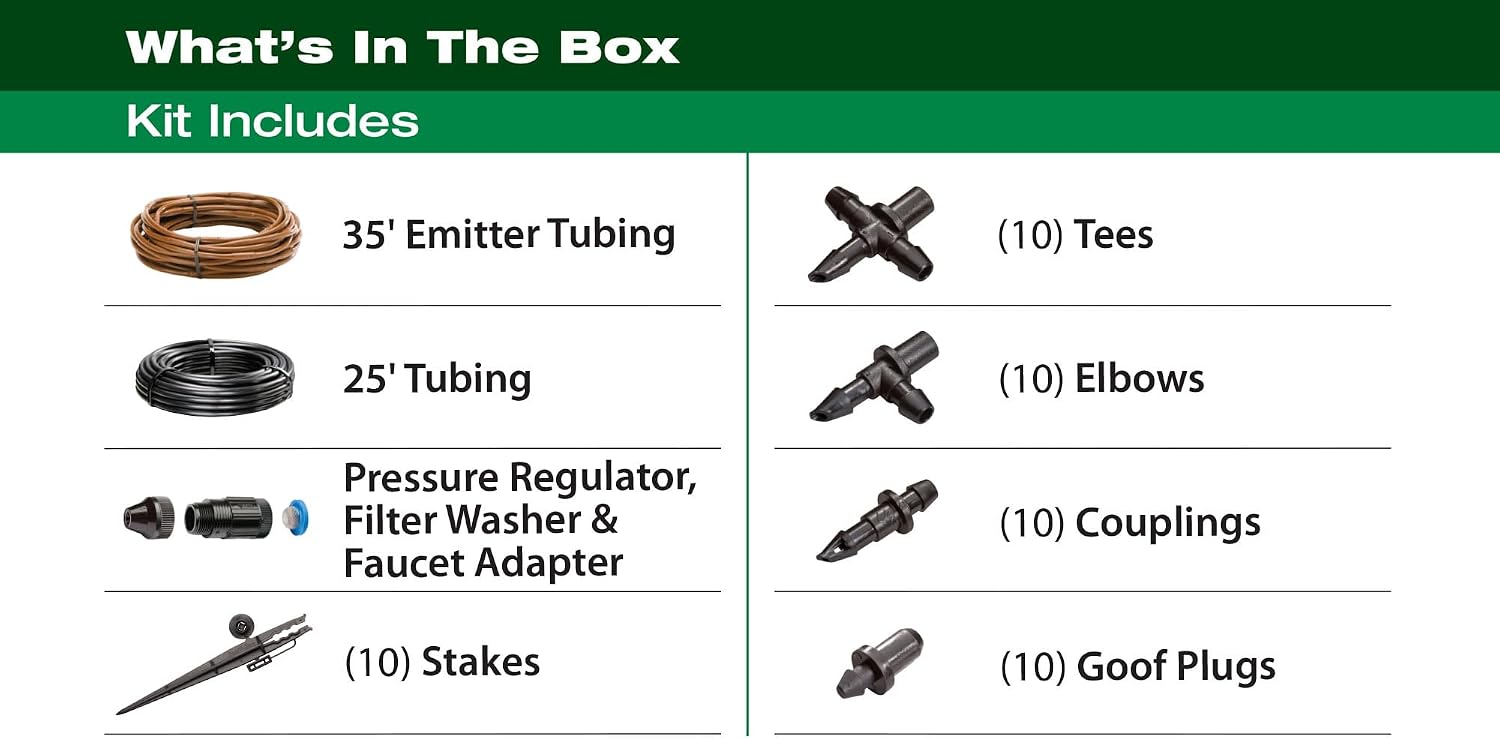
Kits like the Rain Bird DRIP-KIT or comparable Rain Bird and Orbit starter systems ship with 1/2-inch main line, 1/4-inch distribution tubing, and a selection of preset emitters — typically 0.5 GPH and 1.0 GPH options. The Spruce’s overview of drip system setup notes these are genuinely capable for beds up to about 200 square feet, and owners consistently report that the push-in emitter fittings hold pressure reliably on 1/2-inch poly tubing without specialized tools.
The tradeoff: preset emitters mean you’re committing to fixed flow rates at purchase. For a bed where every plant has roughly similar needs — say, a heliconia-dominant bed in full sun — that’s fine. For a mixed bed with shade-grown aroids alongside heliconias, you’ll end up running separate zone lines or accepting uneven delivery.
If X = your bed is dominated by one plant family at similar exposure, then Y = a preset-emitter starter kit is entirely adequate.
Mid-Range: Adjustable-Emitter Kits (~$80–$150)
This is the tier that earns its money in mixed tropical plantings. Kits built around adjustable or pressure-compensating emitters — where you can dial each emitter between 0 and 1.0+ GPH — give you per-plant control without running separate supply lines. Look for kits that specify pressure-compensating emitters (the manufacturer description will use that phrase); these maintain consistent output between roughly 10–50 PSI, which matters if your house water pressure fluctuates or you’re running a long line.
The DIG B21G series and Netafim Woodpecker Junior emitters are two options reviewers in long-run discussions consistently flag for tropical landscape use, particularly for their resistance to clogging with the mineral-heavy well water common in parts of Hawaii. Netafim’s published spec sheets put their Woodpecker Junior at pressure compensation across 7–45 PSI — a meaningful operational range.
For most mixed tropical beds in the 150–400 square foot range, a mid-range kit with adjustable emitters plus a simple digital timer (the kind that attaches to a hose bib and runs on AA batteries, around $25–$45 separately) gives you full automated control without a permanent plumbed system.
If X = your bed mixes sun-loving heliconias with shade aroids, then Y = adjustable-emitter kit + separate zone lines per exposure type.
Upper Tier: Multi-Zone Controllers (~$150–$300 for controller, plus hardware)
If you’re running a serious collector’s garden — multiple beds, rare anthuriums in one zone, a heliconia grove in another, potted specimens on a separate line — a multi-zone timer controller like those in the Orbit B-hyve or Rain Bird ESP-Me series shifts you into genuine irrigation management. These allow independently scheduled zones, so your aroids run two days a week and your heliconias run five, from the same water source.
The cost jump is real, but the math justifies it: CTAHR’s landscape drip guidance notes that poorly scheduled irrigation is a leading cause of both root rot in shade aroids and stunted flowering in heliconias, two problems that show up months after the watering error and are easy to misdiagnose. A multi-zone controller eliminates the scheduling guess entirely.
If X = three or more distinct plant communities with different water needs, then Y = multi-zone controller is the right infrastructure investment, not an upgrade.
Layout Principles for Tropical Beds Specifically
A few layout decisions that trip up growers when they first configure for tropicals:
Run your main line along the bed perimeter, not through the center. Heliconias and large gingers are vigorous rhizome spreaders — per Missouri Botanical Garden’s heliconia cultural notes, established clumps can expand 12–18 inches per year. A main line run through the bed center will get displaced or punctured within two seasons. Perimeter routing with 1/4-inch spaghetti lines extending inward to each plant is more resilient as the planting fills in.
Account for canopy drip shadow. Large-leaf aroids like Alocasia macrorrhiza shed rainfall and irrigation overspray off their leaves, creating a dry zone at the plant’s perimeter while the center stays wet. Emitters should be placed 4–6 inches from the base of the stem — not at the drip line — to keep moisture at the rhizome where it matters.
Flush your system seasonally. The University of Florida IFAS Extension drip guide specifically recommends end-cap flushing every 60–90 days in warm climates where algae and mineral scale can partially block emitters. In Hawaiian gardens with volcanic soil and high mineral content in the water supply, some operators in long-run reviews note they move to a quarterly diluted citric acid flush to maintain emitter output consistency.
Making the Call
Here’s the decision framework distilled:
- Bed under 200 sq ft, similar plant types, one exposure: Preset-emitter starter kit + battery timer. Budget $75–$120 all-in. Done.
- Mixed bed with heliconias, gingers, AND aroids: Adjustable-emitter kit, two zones (sun vs. shade), digital timer with two programs. Budget $120–$200. This is the sweet spot for most serious home collectors.
- Multiple beds, rare specimens, collector-level investment: Multi-zone controller with pressure-compensating emitters per zone. Budget $200–$350 for the controller and hardware. The cost of a single lost Heliconia wagneriana or rare anthurium specimen at $300–$500 makes this math easy.
- Sandy or volcanic cinder soil: Add a second emitter per plant regardless of tier. Double the emitter count in your kit estimate; it’s a $10–$20 adjustment that prevents consistent underwatering at the root zone.
The emitter calculation isn’t intimidating once you break it into plant groups. The real skill is resisting the urge to average across a mixed planting — your heliconia does not want the same schedule as your Anthurium warocqueanum, and your drip system is the one tool that lets you honor both without being in the garden every day.